BantuPayroll and HR that speaks Zimbabwean.
Bantu is a payroll and HR platform built in Harare for Zimbabwean businesses. It runs dual-currency USD and ZiG payroll, files PAYE, NSSA and NEC automatically and gives every employee a self-service portal. I designed the product: the admin workspace, the employee portal and the design system behind both, in light and dark themes.
- Role
- Sole product designer: UX, UI and design system
- Team
- 2 founders, 2 senior developers and an HR & payroll officer
Live
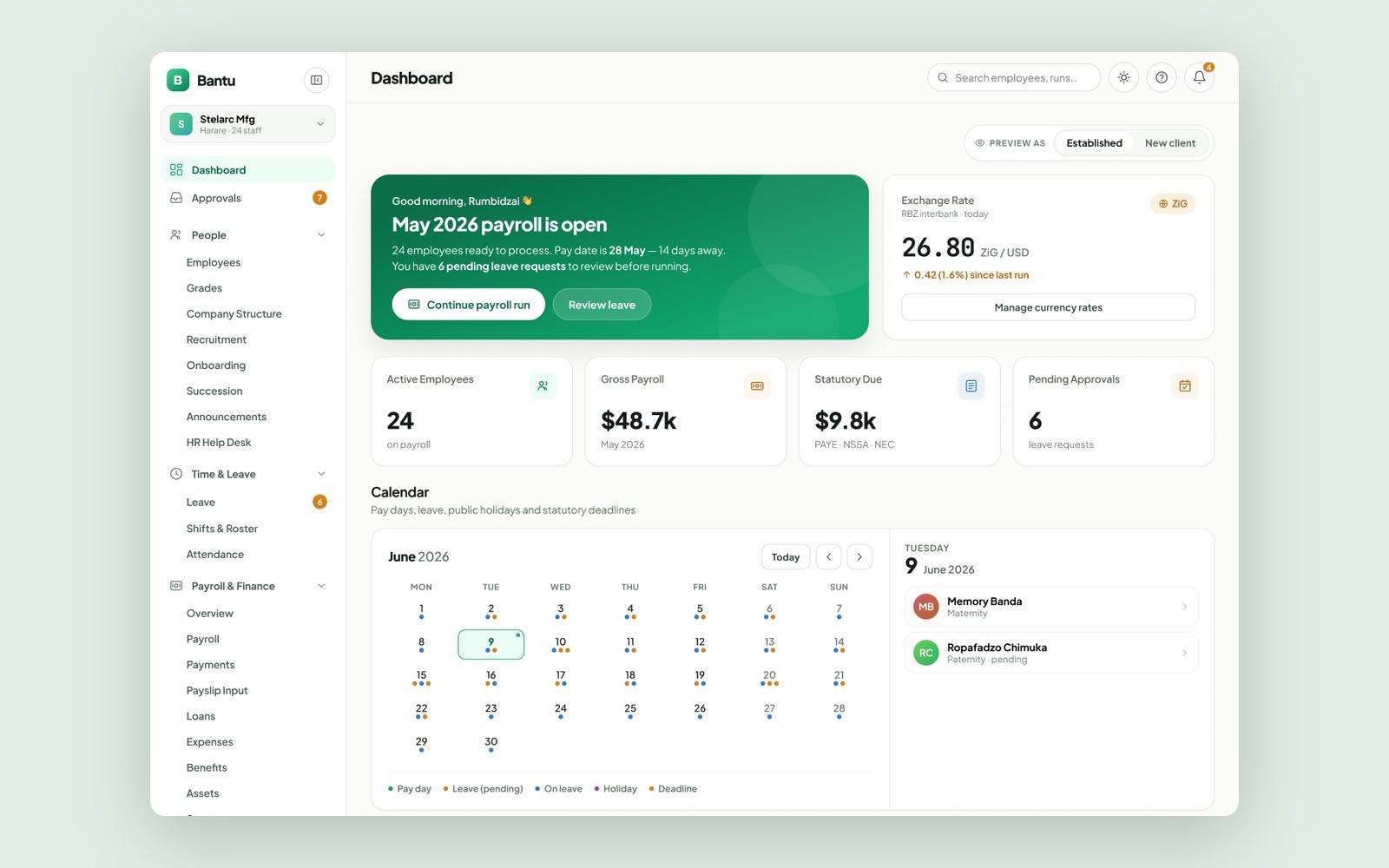
A live product that runs USD and ZiG payroll side by side, with statutory returns generated automatically and every edit traceable.
- Context
- Client project
- Platform
- Web app (admin + employee portal)
- Tools
- Figma
In short
The problem
Zimbabwean payroll is unusually hard: salaries are split between USD and ZiG, exchange rates move, and statutory returns for ZIMRA, NSSA and NEC are due every month.
What I did
I designed the admin workspace (dashboard, people, payroll, leave, approvals, expenses, reports), a 13-screen employee portal and a token-based design system with full light and dark themes.
Context
Payroll in Zimbabwe means paying people in two currencies at once, at an official rate that changes, while calculating PAYE, NSSA, NEC, AIDS levy, SDF and WCIF to the cent. Payroll officers carry a lot of risk, and mistakes are expensive.
Bantu's promise is to make payday calm: one place to run payroll, manage people and file returns, built for local rules rather than adapted from a foreign product.
How I approached it
- 01
Map the payroll job
Mapped a full pay cycle, from attendance and leave to the pay run, payslips, bank files and statutory returns.
- 02
Two products, one system
Split the product into an admin workspace for HR and finance and a self-service portal for employees.
- 03
Build the system first
Defined colour, type, spacing and components as tokens, so every screen works in both light and dark themes.
- 04
Design every screen
Designed the core admin screens and all 13 portal screens on that system.
Key design decisions
- 01
Lead with what payday needs
The dashboard opens with the state of this month's payroll and one clear action, followed by the live ZiG/USD rate, totals, a calendar of pay days, leave and deadlines, and the approvals blocking the run.
- 02
Money you can trust at a glance
Figures use a tabular monospace font so columns line up, both currency legs are shown side by side, and every run has a clear status. Payroll officers can check totals without reaching for a calculator.
- 03
One inbox for every decision
Leave, expense claims, salary advances, profile changes and HR queries all land in a single approvals queue with filters by type, inline approve and decline, and bulk actions.
- 04
Self-service for employees
The employee portal answers the questions HR gets most — latest payslip, leave balance, tax certificates, documents — so people can help themselves.
The design system
Bantu runs on a token-based system: a money-green primary with warm amber accents over a green-tinted neutral ramp, Plus Jakarta Sans for the interface and JetBrains Mono for money. Dedicated USD and ZiG colours keep the two currencies distinct everywhere they appear.
Every token has a light and dark value, so the whole product — and every component — switches theme without one-off fixes.
Reflection
Payroll is a high-trust job. The design work that mattered most was invisible: lining up numbers, naming statuses consistently and making sure nothing important was ever more than one click away.